What is Agentic Data Extraction? Best Platforms and Alternative System
Written by Christina Miranda
Agentic data extraction is AI-powered technology that will capture and understand your data, and go a step beyond OCR and LLMs.
Most companies aren’t struggling to access their data, they’re struggling to understand and use it.
Every invoice, contract, or claim form holds valuable information, yet much of it remains locked in documents that systems can read but not truly interpret.
As AI-powered document processing evolves, the real question isn’t whether machines can extract text anymore, it’s whether they can make sense of it, act on it, and fit into real business workflows without adding unnecessary complexity.
Agentic data extraction is a step beyond OCR, as it can extract and understand your unstructured data.
What is Agentic Data Extraction?
Agentic data extraction is a more advanced approach to what document capture. Data is taken from unstructured documents, such as tables or images, and is converted into structured and readable data.
But how is it different from the systems we have been using until today?
For decades, document automation meant getting a computer to read what a human had written. This was done through OCR. It takes a scanned page or image and converts it into machine-readable text.
However, regular OCR with no other technologies combined lacks understanding that can classify those documents effectively.
ADE represents a more ambitious goal. Rather than simply asking “what does this document say?”, an ADE system asks “what does it mean, what matters, and what should happen next?”
Where OCR hands you a block of raw text, an ADE system hands you structured, actionable data, and often takes the next step automatically.
Take a simple invoice. An OCR tool will faithfully transcribe “Total Amount: €1,250.”
An ADE system will identify that figure as the invoice total, tag the currency as EUR, classify the document type, and route it into an accounts payable workflow without human intervention.
Feature | OCR | Agentic Data Extraction |
|---|---|---|
Output | Raw text | Structured, usable data |
Intelligence | None | Context-aware reasoning |
Flexibility | Template-based | Adaptive |
Example | Extracts invoice text | Identifies vendor, total, due date automatically |
Agentic Document Extraction vs LLMs
Since standard LLM tools and llm gateways such as ChatGPT hit the scene, most users have assumed they can take care of everything.
And while LLMs do, in fact, have a great capability to read, summarize, and point out key facts, they still are text-in, text-out systems. They respond to prompts; they don’t independently manage multi-step workflows.
ADE systems layer structured decision-making on top of that reasoning capability.
If an LLM is the brain, ADE is the brain connected to a nervous system, with memory, workflow logic, and the ability to loop back, verify, and act.
For example, an LLM could summarize a contract; an ADE system will identify it as a contract, extract specific clauses, flag risks, and push relevant data into a CRM or legal register.
An equally important distinction lies in AI confidentiality. While general-purpose LLMs often process data in shared or opaque environments, enterprise-grade ADE systems are designed with stricter data governance in mind with controlled infrastructures, including encryption, access controls, and audit trails.
Capability | LLMs | ADE |
|---|---|---|
Core function | Text generation and reasoning | End-to-end extraction workflows |
Output format | Unstructured text | Structured data pipelines |
Autonomy | Prompt-dependent | Multi-step decision-making |
Reliability | Variable | Designed for consistency |
What Does an Agentic Document Extraction Process Look Like?
A typical ADE system doesn’t process documents in a single pass. Instead it runs through a pipeline following specific steps, each informing the next.
A document arrives, perhaps a PDF invoice emailed to an accounts payable inbox. The system first preprocesses it: running OCR if needed, detecting the page layout, and removing noise.
The reasoning phase is where ADE distinguishes itself.
An agent identifies the document type, decides which fields are worth extracting, and chooses an extraction strategy, adapting on the fly if the format is unusual.
Once fields are pulled, a validation step cross-checks totals, compares data against historical records, and flags anything anomalous.
Finally, clean structured data is sent downstream: to an ERP, CRM, or accounting platform.
To point out clearer steps:
Document ingestion → PDFs, emails, scans, and images are received from any input source.
Preprocessing → OCR is applied if needed, layout is detected, and noise is removed.
Agent-based reasoning → The system identifies document type and chooses an extraction strategy dynamically.
Data extraction → Structured fields are pulled, handling inconsistencies across formats and languages.
Validation and cross-checking → Totals are verified, anomalies flagged, and data compared against historical records.
Output and integration → Clean data is sent to ERP, CRM, or accounting systems, triggering downstream workflows.
If your company receives, for example, 500 invoices a day, this pipeline can deliver automation rates between 80 and 95 percent, reducing per-document handling time to under a minute.
Agentic Data Extraction Use Cases
ADE is most valuable in industries where companies handle a large amount of documents with many different formats.
How would it be used in some popular industries?
Finance
In finance, a common real-world scenario is accounts payable automation.
Companies receive invoices in multiple formats (PDFs, scanned documents, or email attachments) and an agentic system can automatically detect these inputs, extract relevant fields such as vendor details, invoice numbers, and totals, and then cross-check them against purchase orders or historical transactions.
If discrepancies arise, the system flags them for review; otherwise, it posts the data directly into ERP systems.
This reduces manual workload and prevents duplicate payments and fraud.
Another key use case is audit and compliance preparation, where agents continuously scan financial records, extract compliance-relevant data, and map it to regulatory frameworks, producing audit-ready documentation with minimal human intervention.
Legal
In the legal sector, agentic data extraction is particularly powerful in contract analysis and due diligence.
During mergers or large transactions, thousands of contracts must be reviewed. Agents can read through these documents, identify clauses related to liabilities, termination conditions, or obligations, and summarize risks.
They can also compare clauses across documents to identify inconsistencies or missing protections.
In litigation support, similar systems extract key facts, dates, and entities from case files and evidence documents, building structured timelines that lawyers can use to prepare arguments more efficiently.
Insurance
In insurance, claims processing is one of the most impactful applications.
When a claim is filed, it often includes forms, photos, medical reports, and supporting documents. An agentic system can ingest all of these, extract relevant information such as policy numbers, incident details, and damage descriptions, and validate them against policy coverage.
It can even flag suspicious patterns that may indicate fraud.
In underwriting, agents analyze applicant data, historical claims, and external data sources to extract risk indicators and assist in pricing policies more accurately and consistently.
Logistics
Logistics operations benefit from agentic extraction through document automation and real-time decision support.
For example, shipping involves bills of lading, customs declarations, invoices, and delivery confirmations. Agents can extract shipment details, track goods across systems, and reconcile discrepancies between documents. If delays or inconsistencies are detected, the system can proactively notify stakeholders or trigger corrective workflows.
Healthcare
In healthcare, agentic data extraction manages both clinical and administrative data.
Medical records, lab reports, prescriptions, and insurance documents often exist in unstructured formats. Agents can extract patient information, diagnoses, treatment plans, and billing codes, ensuring that electronic health records are accurate and up to date.
In revenue cycle management, these systems also verify that procedures are correctly coded and aligned with insurance requirements, reducing claim denials.
Additionally, they can assist clinicians by summarizing patient histories and highlighting key insights from large volumes of medical data, enabling faster and more informed decision-making.
Across all these industries, the defining advantage of agentic data extraction is its ability to understand, validate, and act on the data autonomously.
Best ADE Platforms
Choosing the proper tools can either be your best asset or your biggest downfall.
If you’re looking for standalone agentic data extraction, there are two major players: LandingAI and Reducto.
However, if you don’t need the ful bandwidth, there are alternative solutions that will save you from having a huge and unnecessary tool stack.
But let’s focus on ADE platforms first:
LandingAI
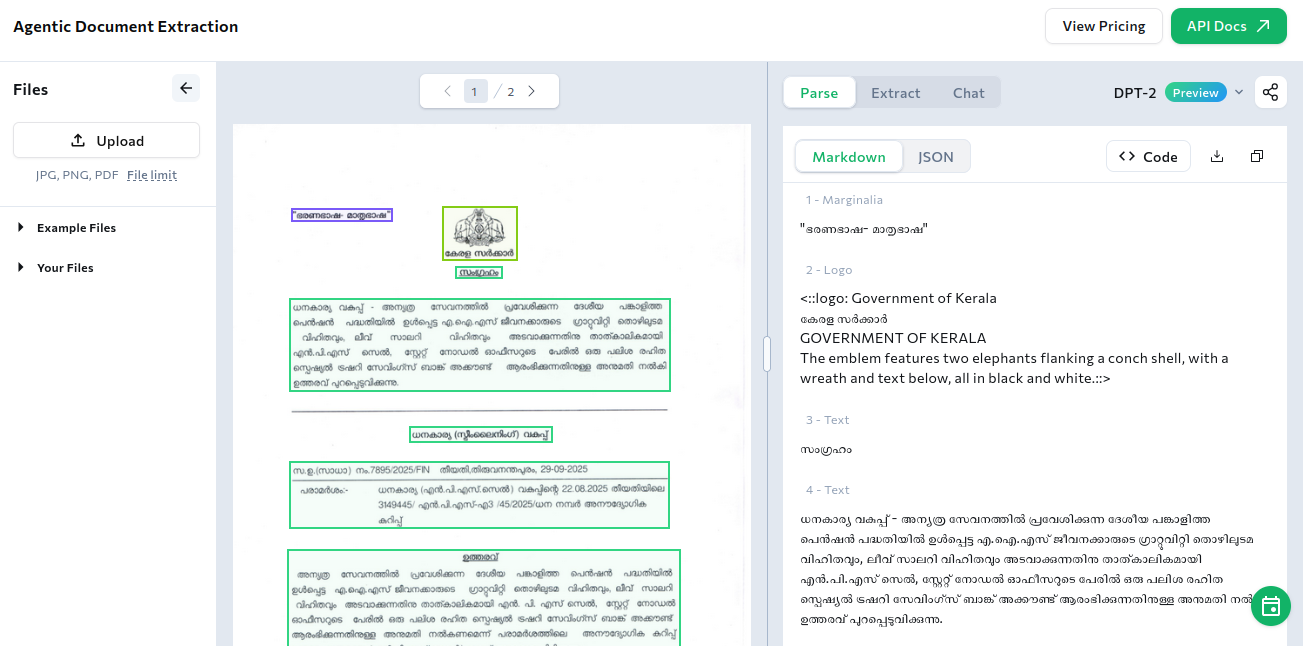
LandingAI offers an API-first agentic document extraction platform designed to convert complex, real-world documents into structured, auditable data.
It combines proprietary vision models with agentic orchestration, allowing the system to interpret layouts, extract structured outputs, and verify results with traceable source grounding such as page references and coordinates.
The platform emphasizes accuracy, transparency, and governance, making it particularly suited for regulated industries like finance, healthcare, and legal. It supports end-to-end workflows through modular APIs that handle parsing, splitting, and extraction, while also enabling downstream automation such as compliance checks or reporting.
Some features include confidence scoring, audit trails, and flexible deployment options.
Reducto.ai
Reducto is an AI-native document ingestion platform focused on transforming unstructured documents into structured, LLM-ready data with high accuracy.
Its approach centers on “vision-first” document understanding, combining computer vision, vision-language models, and what it calls agentic OCR.
Reducto supports a wide range of file types and complex content structures, including tables, forms, and multi-column layouts, while allowing users to define custom schemas for precise JSON outputs. The platform is built for scalability and integration, offering APIs for parsing, splitting, extracting, and even editing documents.
Reducto is positioned as a backend infrastructure layer for teams building AI-powered workflows, particularly where accuracy, flexibility, and LLM integration are key priorities.
When is ADE Overkill?
Here’s a question worth asking before committing to an ADE platform: does your existing system already handle the problem?
Enterprise content management systems have been quietly improving for years.
This is a system that will store and manage all of the content that moves through your organization. And although many still view it as basic document storage, it goes beyond that.
Many now include OCR, AI-powered document classification, intelligent indexing, and automated workflows, features that overlap significantly with what ADE vendors promise.
A modern ECM like Dokmee Capture, for example, can automatically categorize incoming documents, extract metadata without manual tagging, and respond to natural language search queries like “Invoices from March above €5,000”, all without a dedicated ADE implementation.
This blurs the line considerably between traditional ECM and the newer category.
Feature | ECM + OCR | ADE |
|---|---|---|
Document storage | Yes | Yes |
OCR | Yes | Yes |
Rule-based extraction | Yes | Limited |
AI-based extraction | Basic | Advanced |
Adaptability | Low | High |
Setup complexity | Moderate | High |
Cost | Lower | Higher |
Autonomy | Low | High |
If your documents follow consistent templates, your extraction rules rarely change, and you already have OCR and workflow automation in place, a well-configured ECM is likely sufficient.
The added complexity and cost of ADE is only justified when document variability is high, manual review remains substantial despite existing automation, or extraction errors carry serious financial or legal consequences.
Should You Choose ADE or ECM?
Agentic document extraction is an AI-powered tool that will extract and understand the data you feed the platform, and in lage-scale enterprises it can be invaluable.
The real decision isn’t “do I need ADE?” It’s “is my current system failing to handle complexity efficiently?” If the honest answer is no, you likely already have what you need.
ADE platforms are becoming a critical layer for automating data-intensive processes across finance, legal, insurance, logistics, and healthcare.
At the same time, ADE does not replace the need for broader document and content management strategies.
ECM solutions like Dokmee ECM provide the structured foundation for securely storing, organizing, and governing documents throughout their lifecycle.
In practice, many organizations benefit from combining ADE capabilities with ECM systems, using ADE to extract and operationalize data, while relying on ECM platforms to ensure compliance, version control, access management, and long-term record retention.