Full OpenText Review 2026: Features and User Reviews
A clear, detailed OpenText review: document management, AI, capture, automation, pros, cons, and real-user opinions. Find out if OpenText suits your business needs.
A clear, detailed OpenText review: document management, AI, capture, automation, pros, cons, and real-user opinions. Find out if OpenText suits your business needs.
Did you know nearly 80% of enterprise data is unstructured, making content management harder than ever?
This means you need an ECM that offers strong automation and capture to help you solve that issue.
With this OpenText review, we can help you determine if it is the strong automation you need or if it the overly complex platform that can doom your productivity.
What is OpenText?
OpenText is an ECM platform that holds a large variety of different products.
OpenText Content is a central system where documents, records, emails, multimedia files, and business data can be managed throughout their entire lifecycle.
The platform provides tools for content capture, metadata tagging, version control, access management, and retention.
Its primary goal is to reduce information silos and create a single, structured source of truth for organizational content.
OpenText integrates with major business applications such as SAP, Salesforce, and Microsoft 365. This platform embeds content management capabilities directly inside the tools you most likely work with already.
OpenText is built to support organizations with complex operations, regulatory requirements, and large document volumes.
OpenText is known for its extensive feature set and automation.
However, this breadth of functionality also means the platform is more complex than lightweight file-sharing or document-storage tools.
It typically requires dedicated IT support for implementation, configuration, and long-term maintenance.
As a result, OpenText is most often used by medium and large enterprises rather than small businesses.
Who is OpenText For?
As mentioned, OpenText is built for larger enterprises that can afford the cost and a dedicated IT team.
But there’s more to it.
OpenText is a good fit for businesses that have very strict compliance requirements. The platform offers control, governance, and scalability.
Regulated industries, such as finance, government, healthcare, and energy, benefit from OpenText’s emphasis on auditability, security, and retention management. The platform provides the controls and traceability needed to meet strict regulatory standards, so that sensitive information is handled consistently and securely.
It is also an effective ECM for companies that rely heavily on systems like SAP, Salesforce, or Microsoft 365.
However, OpenText is generally not a good fit for small businesses or teams with simple needs.
Its cost, complexity, and administrative overhead often exceed what smaller organizations require.
For companies that need a quick, low-cost, easy-to-use document management tool, lighter alternatives are typically more practical and affordable.
Additionally, to some, OpenText’s architecture can seem excessive, so, even if you need ECM capabilities instead of simple DMS, you might still benefit from other ECM platforms with a modular architecture, like Dokmee.
OpenText’s Best Features
OpenText offers many different products tailored to different departments and needs, but here, we will be focusing essentially on the Content product, where we can find content and document management features.
Document Management
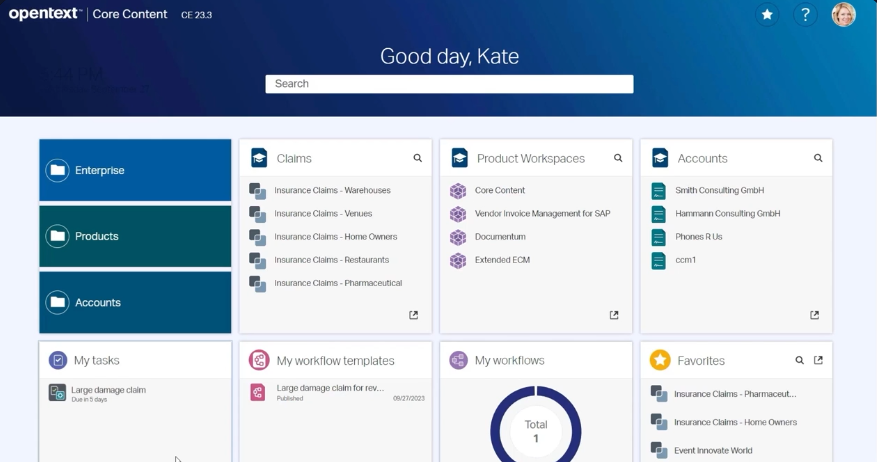
OpenText offers three different document management tiers that serve as the backbone of its ECM solution.
Within OpenText you could choose from OpenText Content Management, OpenText Core Content Management, and OpenText Documentum Content Management.
OpenText Content Management (CM) is the most basic tier and can capture, store, classify, version, and retain documents according to organizational policies, helping break down silos. It acts as a regular ECM.
Core CM provides standard document management but focuses more on collaboration and integration.
It also supports AI-enhanced search, workflow automation, and secure external sharing, making it suitable for organizations that want to simplify business processes and improve productivity across departments.
Lastly, Documentum CM is oriented toward highly regulated industries and environments that require strict governance over content.
Documentum excels in managing complex content lifecycles, compliance, and audit requirements. It supports highly structured content types, such as contracts, engineering documents, and regulated records, and provides sophisticated workflow and retention policies to ensure compliance with legal, industry, or internal standards.
Documentum also allows deep customization of business processes, making it a preferred choice for organizations that need granular control over document handling and regulatory adherence.
AI Content Management
OpenText’s AI-driven content management uses AI and machine learning to automate classification, metadata extraction, and insights from documents.
This feature helps you reduce manual data entry, improve search relevance, and uncover patterns across vast repositories.
For example, AI can automatically categorize invoices, contracts, and emails or flag content for compliance risks.
The primary benefits include increased efficiency, faster document processing, and enhanced decision-making based on intelligent insights.
Limitations include the need for proper AI training, data quality requirements, and potential inaccuracies in complex or non-standard content. Additionally, integrating AI capabilities with legacy systems can sometimes be challenging, requiring technical expertise for optimal implementation.
OpenText Content Aviator
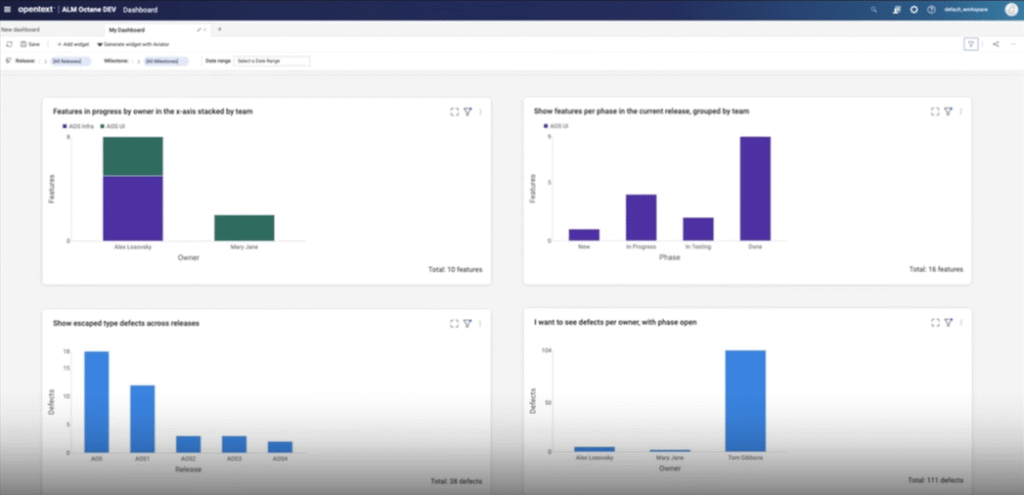
OpenText Content Aviator is a newer interface and search experience designed to provide fast, AI-enhanced access to enterprise content across repositories.
It allows you to search, preview, and retrieve documents quickly, regardless of their storage location.
It offers intuitive navigation, AI-assisted search suggestions, relevance ranking, and integration with multiple OpenText repositories, making it easier for employees to find and use the right content.
However, it greatly relies on proper metadata and tagging to maximize AI search effectiveness, and some users have found the feature less customizable than legacy interfaces.
Additionally, adoption can be slower in teams accustomed to traditional ECM navigation.
Capture
OpenText Capture is an add-on and comes in 3 different tiers too. Including a specific capture tool for vendor invoice management for SAP solutions.
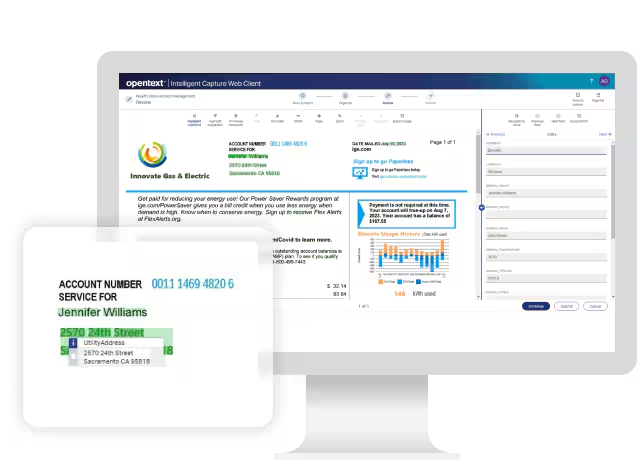
The platform uses OCR, machine learning, and document-classification technologies to automatically ingest, classify, and extract key information (metadata, text, form values, etc.).
OpenText Capture allows for configurable, no-code workflows and export of structured documents and data into back-end systems or content repositories, for example, an ECM, ERP or CRM.
The platform supports hybrid and cloud deployments, and offers interfaces (including web-based clients) that help scale capture operations across offices and geographies.
However, although OpenText’s machine-learning, AI-based classification and extraction are powerful, these systems still depend on good-quality input (scans, readable PDFs, correctly structured documents), and unusual layouts, low-quality images or poor handwriting can degrade extraction accuracy.
Also, configuring capture workflows and validation rules, especially for complex document types or multi-channel ingestion, may require experienced staff or time, which adds to implementation overhead.
Process Automation
Process automation in OpenText is the automated workflow builder you can find in most ECM platforms.
Some processes that can be automated include:
Insurance claims and underwriting automation
Public sector case management digitization
Banking workflow automation and orchestration
Manufacturing operations optimization
Anti-money laundering compliance and risk control enforcement
Invoice and procedure-to-pay workflow automation
The downside is that, as with most OpenText features, you need an experienced team with coding knowledge in order to configure workflows.
For organizations with highly dynamic processes, overly rigid automation can sometimes limit flexibility unless workflows are carefully designed.
OpenText’s Strengths and Limitations
To understand if a tool is a right fit for you or not, consider where it shines and where it could create more bottlenecks than it is solving.
OpenText is a pretty powerful ECM with advanced automation that can be useful for large enterprises that have the resources to afford its upkeep and management.
It can handle large volumes of documents, comply with regulatory standards, and integrate content into business processes.
OpenText also excels in integration, embedding content management directly into core systems such as SAP, Salesforce, and Microsoft 365.
However, OpenText also presents limitations that you might want to consider before taking the plunge.
Its wide variety of tools, products, and tiers often result in significant complexity, both in implementation and ongoing administration.
Establishing metadata models, workflows, permissions, and retention policies typically requires specialized expertise, which can increase deployment time and cost.
The user interface can feel less intuitive compared to modern cloud-native tools, making adoption challenging for non-technical users.
Performance issues may also arise in large-scale deployments if infrastructure and configuration are not optimized.
Finally, the total cost of ownership, including licensing, maintenance, consulting, and training, is generally high, making OpenText less suitable for small organizations or teams with simple document management needs.
What do Users Really Think?
We’ve given you all the data, however, users are the ones who hold the strong reviews. What do they think?
It is important to add that there have been little to no new reviews in 2025.
⭐⭐⭐⭐⭐ Ratings
G2 4.1/5 | Capterra 3.8/5 | Gartner 4.1/5
✔️ Pros
There is a Client Group available to share tips and experiences
Handles a very large amount of documents
Improved time management
Users celebrate process automation
Strong governance and compliance
✖️ Cons
Steep pricing (a major drawback for many users)
Constant updates
Requires previous knowledge
Daunting customization
Additional training resources required during implementation
Is OpenText the Right ECM for You?
If you have a large enterprise and can afford to dedicate time to train your teams, OpenText can be quite a suitable ECM.
OpenText has a large ecosystem of tools to build a strong enterprise content management platform.
Its purpose is to eliminate information silos and create a single, governed source of truth that integrates smoothly with major business applications like SAP, Salesforce, and Microsoft 365.
For enterprises with strict compliance requirements, high document volumes, and deeply integrated processes, OpenText delivers the control, scalability, and automation needed to keep information accurate, secure, and accessible throughout its lifecycle.
However, this strength also introduces complexity.
OpenText is not a lightweight document management tool, it requires experienced administrators, careful planning, and investment in both infrastructure and training.
While its AI capabilities, advanced workflows, and industry-grade governance are major advantages, they come with steep licensing costs.
If you’re looking for an equally strong platform with both coded and no-code workflows, that also includes a modular design at affordable pricing, check out Dokmee ECM or DMS, for the smaller companies.