How to Use a DMS in Sales and Marketing to Close More Deals
Close deals faster with a DMS in sales and marketing teams to ensure the same documents are shared in real-time to deliver consistent messaging within the company and with leads.
Close deals faster with a DMS in sales and marketing teams to ensure the same documents are shared in real-time to deliver consistent messaging within the company and with leads.
79% of marketing leads never convert to sales due to faulty lead nurturing.
This can happen when sales and marketing teams and completely aligned or don’t have immediate access to the same documents.
A DMS in sales and marketing solves this issue and bring both teams together to close deals with quality leads faster than ever.
What is a DMS in Sales and Marketing
A document management system is a platform created to store, organize, manage, and share all of your company’s documents in a unique space.
However, it extends far beyond simple storage.
In sales and marketing, a DMS is a single source of truth where both teams can align on strategies, internal content, proposals, contracts, pitches, case studies, campaigns, and reports.
Both teams need to work alongside each other and need access to the most recent and updated documents and can ill-afford bottlenecks and slow workflows.
Without a DMS, sales and marketing teams often work from disconnected folders, outdated files, or email attachments. This leads to version confusion, inconsistent messaging, and lost opportunities.
A DMS like Dokmee guarantees that everyone accesses the latest approved documents, follows compliance standards, and collaborates efficiently across departments.
For example, when marketing updates a product datasheet with new pricing or messaging, sales teams immediately access the revised version, eliminating the risk of sending outdated information to prospects.
What features do you need?
There are some DMS features that are crucial for your teams to work together and keep full control of all documents and other content.
Essentially, a DMS for sales and marketing must support speed, collaboration, and control, for example:
Centralized file cabinets
All sales and marketing materials should be stored in one structured location with logical folders and metadata.
This allows teams to quickly find documents by campaign, industry, product, or region.
Search and indexing
Advanced search capabilities and automated indexing allow teams to locate documents using keywords, tags, or document types.
For example, a sales rep can instantly find a “Healthcare Case Study – Q2 Campaign” before a client meeting.
Secure access and permissions
Marketing may create content, while sales distributes it externally.
Role-based permissions ensure sensitive documents like pricing sheets or contracts are only accessible to authorized users.
Workflow automation
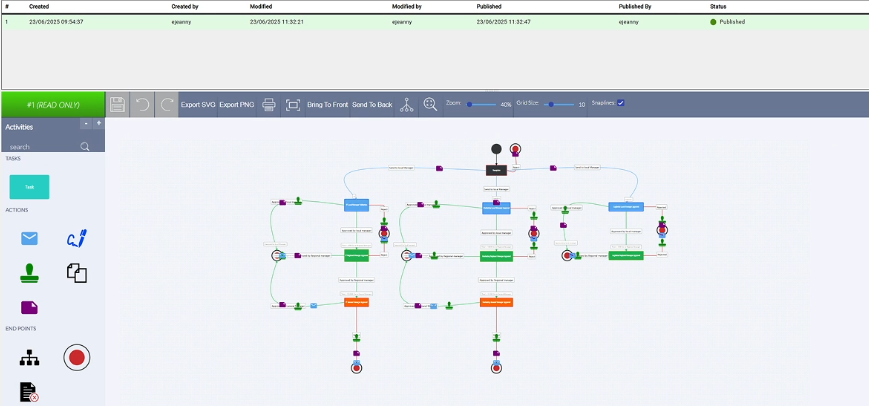
Approval workflows help marketing route materials to legal or leadership before release, ensuring sales only uses approved assets.
Version control and audit trails
Sales proposals and marketing assets change frequently, especially during drafting periods.
Accessing outdated documents can bring chaos and negatively impact the whole process.
Version control guarantees teams always use the most recent file, while audit trails track who edited or approved documents, which critical for regulated industries.
How to Use a DMS in Sales
As we have mentioned earlier, a DMS is more than document storage, however it can be a real life saver for sales reps.
Sales teams rely on speed, accuracy, and consistency to meet revenue targets.
A DMS supports the complete sales cycle, from early prospect engagement to final contract execution, by ensuring sales professionals always have access to the right documents at the right time.
These are some scenarios in which a document management system will influence your sales team.
Proposal and contract management
Sales reps manage a high volume of proposals, contracts, pricing sheets, and terms documents. With a DMS like Dokmee, all documents are stored in secure digital file cabinets and can be organized by client, industry, product, or campaign.
Instead of recreating proposals for every opportunity, sales teams can use pre-approved templates that reflect current branding, pricing structures, and legal requirements, and with annotations of strategies that have been used in other proposals.
This reduces errors, ensures compliance, and greatly shortens the sales cycle.
Version control guarantees that only the most current documents are used, while audit trails track changes and approvals, therefore providing transparency and accountability throughout the process.
For example, a sales rep responding to a time-sensitive RFP accesses Dokmee to locate a pre-approved proposal template aligned with the prospect’s industry.
They customize the document with client-specific details, attach relevant case studies, and submit the proposal the same day. This speed improves responsiveness but also positions the company as professional and well-prepared, increasing the likelihood of closing the deal.
Sales enablement
Effective sales enablement depends on delivering relevant, up-to-date content at every stage of the buyer’s journey.
Dokmee provides sales teams with immediate access to the latest brochures, presentations, product sheets, and case studies created by the marketing team.
Marketing teams can update or replace documents centrally, ensuring sales always shares approved and consistent messaging with prospects. This eliminates the risk of outdated pricing, incorrect product information, or off-brand materials being used in customer conversations.
During a product launch campaign, marketing updates a new pitch deck and uploads it to Dokmee.
Sales representatives that are preparing for client meetings automatically access the updated presentation without requesting files or confirming versions, allowing them to confidently present the latest value proposition.
Deal history and documentation
A DMS allows sales teams and managers to maintain a complete and searchable record of all deal-related documentation, including proposals, contracts, amendments, and supporting materials.
This historical insight is invaluable for forecasting, coaching, and strategy refinement.
Sales managers can review previous deals to identify patterns such as which proposals closed fastest, which pricing models were most successful, or which case studies resonated most with specific industries.
Additionally, Dokmee allows for annotations in documents so both teams can exchange comments to add extra insights.
Take, for instance, a sales manager who is preparing a new campaign for mid-market clients reviews closed-won deals from the past year within Dokmee.
By analyzing the documents used in successful deals, the team identifies messages and content that can be reused and refined, therefore improving consistency and increasing conversion rates across future opportunities.
How to Use a DMS in Marketing
Marketing teams are responsible for creating, updating, and distributing a high volume of content across multiple campaigns, channels, and audiences.
A DMS like Dokmee provides the structure and control needed to manage this content efficiently while ensuring smooth collaboration with sales teams.
By centralizing assets, automating approvals, and providing visibility into content usage, a DMS enables marketing teams to work faster, maintain brand consistency, and directly support revenue-generating activities.
Campaign asset management
A DMS allows marketing teams to organize all campaign-related materials in a unique location.
Landing page copy, email templates, presentations, product datasheets, social media visuals, and sales collateral can be grouped under unified campaign folders with clear naming conventions and metadata.
This structure deletes confusion and ensures sales teams can easily locate the exact materials they need for specific campaigns or target audiences.
Marketing teams can also update or replace assets without disrupting sales workflows, ensuring content remains current throughout the campaign lifecycle.
For example, during a multi-channel product launch campaign, the marketing team uploads all approved assets to a dedicated campaign folder in a DMS.
Sales teams receive automatic notifications and can immediately access the latest pitch decks, one-pagers, and case studies. This removes the need for back-and-forth emails and allows sales representatives to engage prospects with confidence from day one.
Content approval and compliance
Marketing content often requires review and approval from multiple stakeholders, including brand managers, legal teams, and compliance officers.
A DMS can help you implement automated approval workflows that ensure documents are reviewed in the correct order before being released to sales. These can be built easily with a drag-and-drop interface so you don’t require the assistance of an IT team.
As simple as shown in this video:
Version control guarantees that only approved materials are accessible, while audit trails provide visibility into who reviewed, edited, and approved each document.
This is especially important for industries with strict regulatory requirements, where outdated or non-compliant content can create legal or reputational risk.
If a marketing team is creating a financial services campaign, they can route brochures and datasheets through an automated approval workflow.
Legal and compliance teams review and approve the content directly within the system. Once finalized, sales teams automatically gain access to the approved versions, eliminating the risk of sharing unapproved or outdated materials with prospects.
Performance analysis and optimization
A DMS provides valuable insights into how content is used across sales teams and campaigns.
By tracking document access, downloads, and sharing activity, marketing teams can identify which assets are most effective at supporting sales conversations.
This data helps marketing teams refine messaging, prioritize high-performing content, and retire underused materials. It also strengthens collaboration with sales by allowing data-driven discussions around what content resonates most with prospects.
For instance, after completing a quarter-long campaign, marketing reviews document usage reports in Dokmee and discovers that a specific case study is consistently used in closed-won deals.
The team expands this content into additional formats and aligns future campaigns around similar messaging, improving sales effectiveness and campaign ROI.
Benefits of Using a DMS
The greatest benefit of using a DMS like Dokmee is the strong alignment it creates between sales and marketing, particularly when executing specific campaigns.
When both teams work from a shared system, documents, messaging, and campaign objectives remain synchronized, reducing friction and enabling a more coordinated go-to-market strategy.
A DMS improves collaboration by providing a centralized document library that both sales and marketing teams can access in real time.
Instead of working in silos or relying on email attachments and shared drives, teams collaborate within a single platform. Marketing can clearly organize assets by campaign, audience, or region, while sales can quickly identify which materials are relevant to their current opportunities.
This shared visibility ensures that campaign goals, timelines, and messaging remain consistent across departments.
Campaign execution also becomes greatly faster.
Marketing teams can publish approved materials once, knowing that sales teams will immediately have access to the latest versions. This deletes delays caused by manual file sharing or version confusion and allows sales teams to engage prospects as soon as a campaign goes live.
As a result, your company can respond quicker to market opportunities and competitive pressures.
A centralized DMS also guarantees consistent messaging across all sales and marketing channels.
Every proposal, presentation, email attachment, and datasheet reflects the same brand voice, positioning, and value proposition. This consistency builds credibility with prospects and reinforces brand trust, especially during multi-touch campaigns where buyers interact with both marketing content and sales representatives.
Ultimately, better collaboration and alignment lead to higher deal conversion rates.
When sales teams have immediate access to high-quality, campaign-specific content, they can tailor conversations more effectively and address prospect needs with confidence.
Marketing benefits as well by gaining insight into how content supports revenue outcomes, allowing both teams to continuously refine their approach and close deals more efficiently with a DMS like Dokmee.
Close Deals With Dokmee
Dokmee empowers sales and marketing teams to work together without friction by centralizing documents, with automated workflows, and content accuracy.
With real-time access to approved materials and improved collaboration across campaigns, teams can focus on what matters most: building relationships and closing deals.
Dokmee aligns sales and marketing teams in order to transform document management into a competitive advantage, helping your company move faster, communicate better, and, ultimately, close more deals.
Book your demo today.