Complete IBM FileNet Review 2026 With Features and Pricing
What is IBM FileNet Content Manager?
IBM FileNet Content Manager is an ECM platform that manages all business content at large scale.
Like other ECM platforms, FileNet combines content management with workflow, governance, lifecycle management, search, integrations, and content-based application development.
The difference with other platforms is that it is built with the feature set and capabilities that very large enterprises might need.
Its capabilities include document and content storage, versioning, retention, lifecycle management, enterprise search, workflow automation, and records and compliance controls.
FileNet also provides APIs and integration tools to connect content management with other business tools, including Salesforce or Microsoft.
IBM has also expanded FileNet's AI capabilities.
The platform supports AI-powered content classification and data extraction, and the IBM Content Assistant adds generative AI capabilities so you can ask questions about content and generate summaries.
You can apply access controls and policies to enterprise content while managing retention, records, and other compliance requirements.
FileNet is available as a cloud-native platform and is designed to scale across large content environments, including organizations with multiple repositories, departments, and business processes.
Who is IBM FileNet for?
IBM FileNet is primarily designed for very large enterprises with complex content management requirements.
Its extensive feature set can be useful when you need to manage extreme volumes of content across multiple departments, locations, repositories, and business processes.
You are more likely to need a platform like FileNet if your organization has:
Very large document and content volumes
Multiple departments or repositories that need centralized governance
Complex retention, records management, or compliance requirements
Highly structured and interconnected workflows
Large-scale document and content processing
Existing IBM infrastructure or applications
Dedicated IT and system administration resources
Extensive integration or custom application requirements
Complex security and access-control requirements
For these environments, FileNet's breadth can be an advantage because you can use one platform for content management, workflow, governance, search, and related enterprise processes.
However, that level of functionality is not necessary for every organization. In fact, more often than not, its complexity and pricing outweigh the benefits.
You may not need FileNet's full enterprise architecture if you are mainly looking for:
Secure document storage and retrieval
Document version control and metadata
Standard approval and review workflows
OCR and automated indexing
AI-powered search and document analysis
Retention and access controls
Microsoft Office and other standard integrations
Predictable per-user software costs
This is where a more focused DMS such as Dokmee can be relevant.
IBM FileNet Content Manager features
FileNet’s feature set is designed to handle large and distributed content environments rather than simply providing a central location for employees to store files.
Document and content management
FileNet’s content folders have the basic storage features where you can classify content with metadata. Documents have version control and add check-in and check-out for controlled document editing.
The platform also supports content lifecycle management, including records management and retention policies.
One of FileNet's more enterprise-oriented capabilities is its ability to work with content stored across disparate repositories and file shares.
FileNet also supports content consolidation and federated content management, making it possible to apply consistent management, security, and governance policies across different respositories, instead of storing information in different files (or cabinets) inside a unique platform.
For organizations with a more straightforward document environment, however, this level of content federation and enterprise management can add complexity without necessarily providing a corresponding benefit.
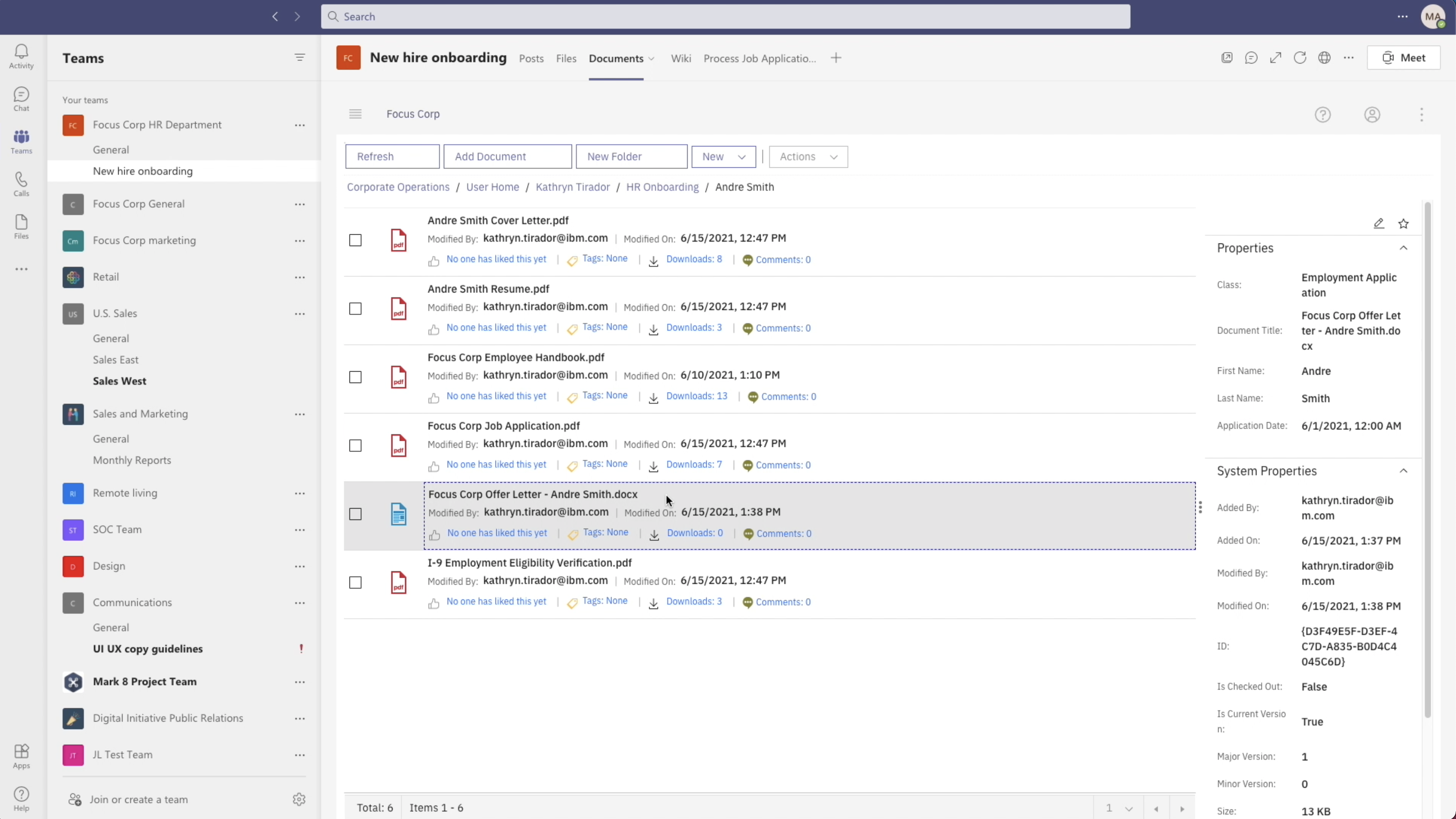
Search
FileNet provides several ways to find and work with enterprise content, including metadata and full-text search across managed content.
Its federated content services also allow organizations to work with content distributed across repositories and file shares rather than relying on a single document repository.
IBM Content Assistant allows you to interact with documents using natural-language questions and retrieve information from individual documents, multiple documents, or content across a repository.
It can also generate document summaries and compare documents or different versions.
Content Assistant uses IBM watsonx LLms together with retrieval-augmented generation (RAG).
When you submit a question, FileNet identifies relevant document content and provides that context to the LLM before generating a response.
Content Assistant is offered as a managed SaaS add-on to an existing FileNet Content Manager environment. The AI functionality is part of a broader enterprise content platform rather than a lightweight AI search feature that you can add to a typical DMS.
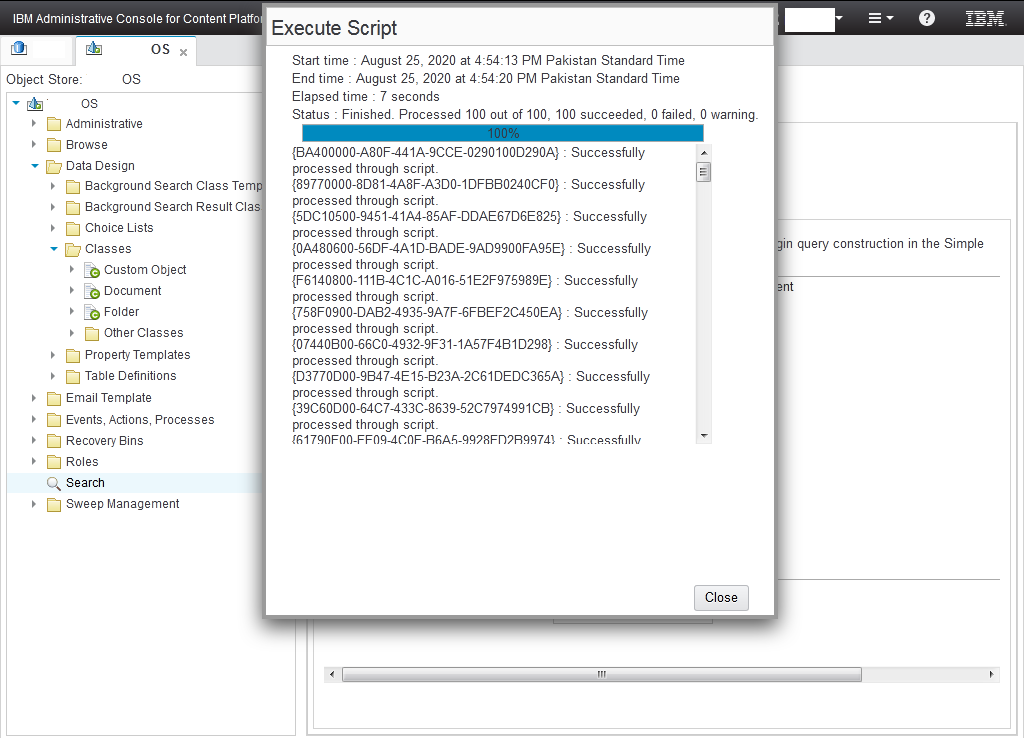
FileNet also supports search scripts, which let you customize how searches are executed and how results are returned. Administrators and developers can use scripts to define more specific search logic and tailor queries to an organization's content structure and business requirements.
This is particularly relevant in large, complex environments where users may need to search across different content types, repositories, metadata fields, or business processes.
Workflow and process management
FileNet's process capabilities can connect activities across different systems and process engines, allowing organizations to coordinate internal and external processes rather than treating document management as a standalone function.
IBM describes its process orchestration capabilities as a way to integrate and coordinate web services across enterprise processes.
You can also build content-based applications around FileNet services. Its development tools and APIs allow organizations to incorporate document management and workflow functions into custom applications, while automated routing can move content and tasks to the appropriate users or stages of a process.
This breadth is useful when you need to manage documents as part of complex, organization-wide processes.
AI capabilities
IBM uses AI to automate document classification and data extraction, improve access to unstructured content, and support natural-language interaction with documents.
FileNet can use AI to classify documents and extract important information from them. IBM has also expanded these capabilities so that AI can work with document properties and metadata, including classification and reclassification based on document content.
IBM Content Assistant adds generative AI to the platform.
You can ask natural-language questions about one or multiple documents and retrieve answers from content stored in your FileNet repositories. The feature uses LLMs and retrieval-augmented generation (RAG) to provide responses based on relevant enterprise content.
You can also use AI for tasks such as summarizing documents and comparing documents or versions.
More recent FileNet developments extend AI further through agents that can interact with enterprise content and perform operations such as searching, retrieving, classifying, extracting, and managing document metadata.
IBM introduced MCP-based content services that allow AI systems to interact with FileNet content while enforcing existing security and governance controls.
For a large organization, this means AI can be applied at several stages of content management: ingesting and classifying documents, extracting information, finding content, understanding documents, and taking actions on that content.
However, FileNet’s AI takes over similar tasks than other ECM platforms, such as AI-powered indexing, summarizing, AI search, etc.
The relevant difference for your evaluation is therefore less about whether each platform has AI and more about how deeply AI is integrated into the wider platform and whether you need FileNet's broader enterprise infrastructure to support it.
Integrations and APIs
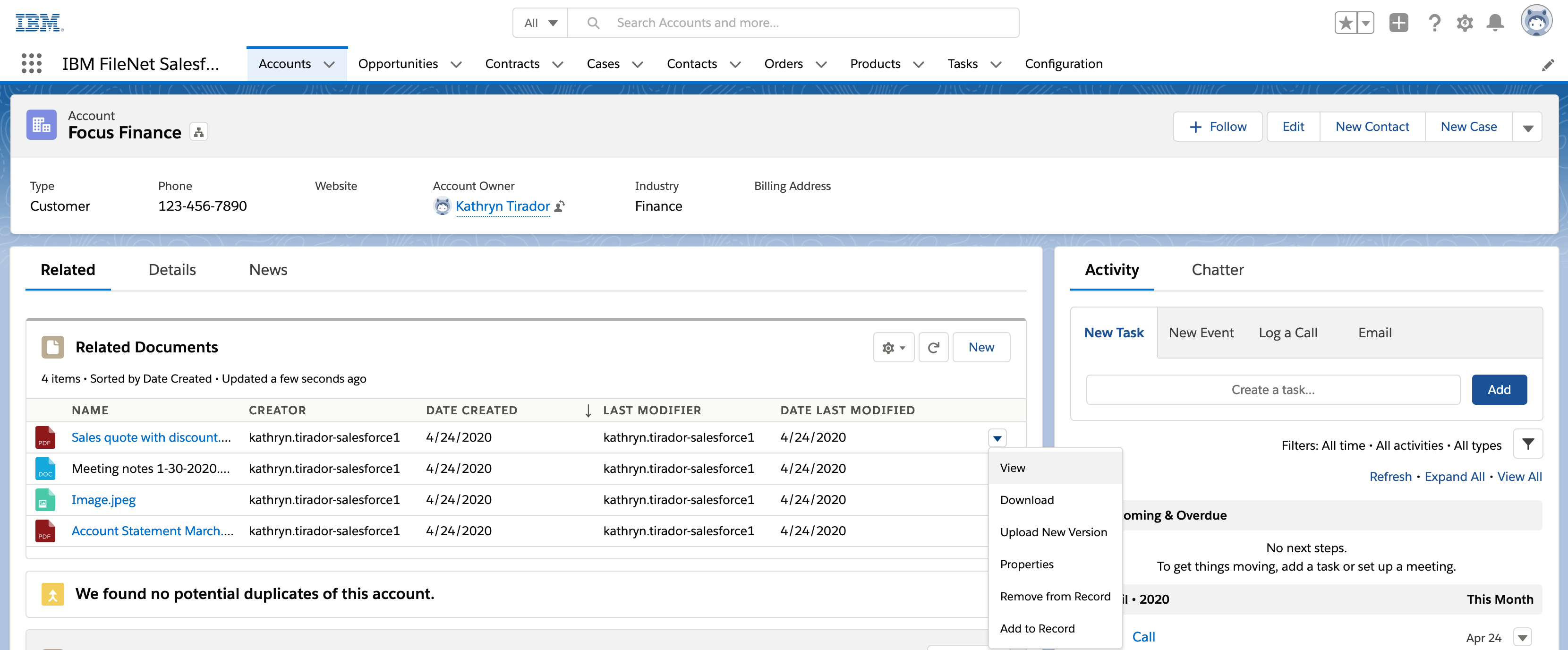
FileNet can integrate it with applications such as Microsoft Office, Microsoft SharePoint, and Salesforce. IBM specifically highlights Salesforce integration for uploading, indexing, editing, collaborating on, and governing sales and service content.
For custom integrations, FileNet provides GraphQL APIs and low-code development tools.
These allow developers and business users to build applications that use FileNet content services, while APIs can connect the platform with external applications and business processes.
The platform also fits into IBM's broader enterprise automation ecosystem. FileNet can work alongside IBM services for workflow, document processing, decision management, and other automation requirements, which is particularly relevant if you already have a significant IBM technology footprint.
FileNet is built to serve as an enterprise content-services layer that other applications and processes can build on.
IBM FileNet pricing
Currently, IBM does not publish a standard per-user price on its current product page and instead directs prospective customers to contact IBM for pricing.
Disclaimer: The numbers we are working for have been reported to us and should be taken as a guideline and estimate.
The reported FileNet price is around $200 per user per month.
Actual enterprise contracts can vary depending on deployment, licensing terms, users, and added features.
At a reported $200 per user per month, the cost increases rapidly as you add users:
50 users = $10,000/month
100 users = $20,000/month
500 users = $100,000/month
1,000 users = $200,000/month
1,000 users = $2.4 million/year
FileNet's higher cost reflects a platform built for complex enterprise content environments. The platform includes extra features that you might not find in other standard ECM platforms, including:
Enterprise-scale content architecture
Federated content management
Custom content-centric application development
Integration with the wider IBM ecosystem
These capabilities can be valuable when you need to manage content across multiple repositories, departments, applications, and business processes, however, many users have reported that these features don’t make up for the high pricing.
IBM FileNet user reviews
⭐⭐⭐⭐⭐ Ratings
G2 4/5 | Capterra 4.5/5 | TrustRadius 10/10
Users appreciate the high level of customization the platform offers for most complex business requirements, as well as its large-scale content management and federated content architecture.
It fits nicely into large enterprises where single dashboard platforms can be restricting.
These strengths are particularly apparent in reviews from larger organizations. For example, users describe FileNet being used for patient records, financial documents, and other high-volume or highly regulated content environments.
The most consistent criticisms, on the other hand, relate to complexity and administration. Some users describe the interface as difficult to navigate, while administrators report a learning curve when configuring metadata, document types, workflows, and other custom elements.
Reviews also mention lengthy upgrades, integration and migration challenges, limited collaboration features, and areas where the user interface and reporting could be improved.
Pricing and overall cost are another consideration. FileNet’s implementation is expensive for organizations with limited IT resources.
✅ Pros | ❌ Cons |
|---|---|
Extremely broad enterprise feature set | Very high reported licensing cost |
Strong workflow and process capabilities | Can require substantial configuration |
Advanced governance and security | More complex than a basic DMS |
Enterprise-scale architecture | Public pricing is not transparent |
AI-powered classification and extraction | Cost increases substantially with user count |
Generative AI capabilities | May include functionality smaller organizations do not need |
Extensive integration/API capabilities | Implementation and administration can be demanding |
Strong fit for complex enterprise environments | Value depends heavily on scale and requirements |
IBM FileNet alternatives
If FileNet's feature set is broader than you need (or its licensing costs are difficult to justify) there are DMS and ECM platforms that cover core document management requirements at a substantially lower cost.
The right alternative depends on how much of FileNet's enterprise architecture you actually use.
If you need federated content management, highly complex process orchestration, extensive custom application development, and deep integration with the IBM ecosystem, FileNet's broader platform can be relevant.
If your requirements center on document management, workflow, security, search, AI, and content governance, a more focused DMS may provide the functionality you need with less complexity and a lower licensing commitment.
Dokmee is a more focused alternative for organizations that want DMS and ECM capabilities without adopting a platform built primarily for highly complex enterprise content environments.
Dokmee covers core requirements including document management, workflow, permissions, OCR, indexing, AI search, AI-powered document processing, retention, and integrations. It also supports cloud, on-premises, and hybrid deployment, giving you flexibility over how your content is hosted and managed.
How do both platforms compare?
IBM FileNet | Dokmee | |
|---|---|---|
Document management | ✓ | ✓ |
Workflow | ✓ | ✓ |
Security and permissions | ✓ | ✓ |
AI capabilities | ✓ | ✓ |
AI search | ✓ | ✓ |
Classification and extraction | ✓ | ✓ |
Enterprise integrations | Extensive | Broad (API integrations available) |
Customization | Extensive | Extensive |
Pricing | High | $39/user/month |
Complexity | High | Lower with extensive support |
Best suited to | Complex enterprise content environments | Organizations that need strong DMS/ECM with AI |
The main difference is not simply the number of features available.
FileNet is built as enterprise content infrastructure, with capabilities that allow users to manage content across different repositories, orchestrate complex processes, develop content-centric applications, and integrate with a wider IBM environment.
Dokmee takes a more focused DMS/ECM approach.
You can manage documents, automate workflows, apply security and retention policies, index content, and use AI-powered search and document processing without adopting the broader architecture associated with FileNet.
This can make Dokmee a more relevant option when you need substantial document management capabilities but do not need FileNet's full enterprise content-services infrastructure.
When is IBM FileNet the best option?
IBM FileNet Content Manager is built for organizations with demanding content environments.
It combines document management with workflow, governance, federated content management, enterprise integrations, custom application development, and increasingly sophisticated AI capabilities.
For large organizations that manage distributed repositories, complex processes, and significant compliance requirements, that breadth can be useful.
The question is whether you really need all of it.
At the reported $200 per user per month, FileNet can become a multimillion-dollar annual software expense as user numbers increase, even before implementation and operating costs.
For an organization that relies on FileNet's enterprise capabilities or other IBM solutions, that investment may be justified.
For an organization that is primarily looking for secure document management, workflow, search, OCR, and AI, it is reasonable to evaluate whether a more focused DMS can meet those requirements at a substantially lower cost.
Dokmee takes that more focused approach, combining document management, workflow, security, indexing, AI search, and ECM capabilities without positioning the platform as the underlying content infrastructure for an entire enterprise ecosystem.
For organizations that do not need FileNet's full range of enterprise capabilities, the difference in complexity and licensing cost can be significant.
The choice ultimately comes down to what you need your content management platform to do, how complex your environment is, and how much you are prepared to invest in those additional capabilities.
For a straightforward DMS platform with all the features you need for effective (and advanced) document management, request a free demo with Dokmee today.