8 DMS Benefits That Will Change Your Business
A DMS benefits efficiency, accuracy, and collaboration across all departments while reducing document chaos and compliance risk. Learn how.
A DMS benefits efficiency, accuracy, and collaboration across all departments while reducing document chaos and compliance risk. Learn how.
A document management system is more than a new platform to store all of your documents.
It can be a lifesaver for efficiency, communication, and accuracy.
A DMS benefits all departments in your company. If you’re doubtful, stay with us.
What is a DMS?
A document management system is a platform designed for the management of your documents including storage, retrieval, archival, retention, sharing, etc.
The goal of a DMS is to have all of your company’s documents in a unique repository instead of having them scattered across email inboxes, local drives, or shared folders. To put it simply, a document management system brings all your data into a single, controlled environment.
A DMS combines secure storage, metadata indexing, version control, access permissions, audit trails, and workflow automation.
More advanced systems extend into enterprise content management, automated document capture, eForms, and compliance enforcement. The result is not just better file storage, but a structured way to ensure documents are accurate, accessible, compliant, and always up to date.
In modern organizations, documents are operational assets.
Contracts, invoices, HR records, policies, engineering drawings, and customer files directly affect revenue, compliance, and decision-making. A DMS guarantees those assets are managed intentionally.
When Do You Need a DMS?
Most organizations don’t wake up one morning and decide they need a DMS. The need usually becomes obvious through friction.
After different teams spend increasing amounts of time searching for documents. Different departments unknowingly work from different versions of the same file.
Approvals stall because someone is “waiting on the latest copy.” Sensitive documents are emailed around without proper controls. Compliance requirements grow, but manual retention processes can’t keep up.
For example, a finance team closing month-end may discover that invoices are stored in email inboxes, shared drives, and physical folders. Each request for backup documentation turns into a scavenger hunt.
Meanwhile, management expects faster reporting with fewer errors. This is the moment when a DMS stops being a “nice to have” and becomes essential infrastructure.
Organizations also reach this point when they scale. What worked for ten employees fails at fifty. What worked for fifty collapses at two hundred. A DMS provides the structure needed to grow without document chaos.
8 Benefits of a DMS
A DMS brings many benefits to your organization’s efficiency and document control. Listed here are 8 if the most positive benefits:
Better communication and collaboration
A DMS centralizes collaboration by allowing different departments to work within the document itself rather than around it.
Comments, annotations, mentions, approval statuses, and task assignments ensure every conversation is tied directly to the file in question. This eliminates fragmented communication across email threads, messaging apps, and shared drives, which often leads to missed feedback and conflicting changes.
The impact of this is especially clear in cross-functional environments. When documents move between departments, a DMS preserves context.
Reviewers can see prior feedback, understand decision history, and respond without restarting conversations.
In accounting and finance, month-end close often requires coordination between AP, AR, and leadership. With a DMS, financial statements are reviewed collaboratively, questions are commented directly on line items, and approvals are clearly recorded. This reduces closing cycles and audit risk.
In legal teams, contracts are frequently reviewed by multiple members. A DMS allows legal, finance, and executives to annotate the same agreement, track changes, sign documents, and approve versions without circulating attachments. The result is faster turnaround and fewer execution errors.
In construction, project documents such as drawings, permits, and change orders are shared between field teams, engineers, and project managers. A DMS guarantees everyone references the same documents and sees updates immediately, preventing costly mistakes caused by outdated plans.
Secure document storage
A DMS provides enterprise-grade security through encryption, role-based permissions, and comprehensive audit trails.
Documents are protected from external threats but also from internal misuse, whether accidental or intentional.
Every access, edit, or download is logged, creating full visibility and accountability.
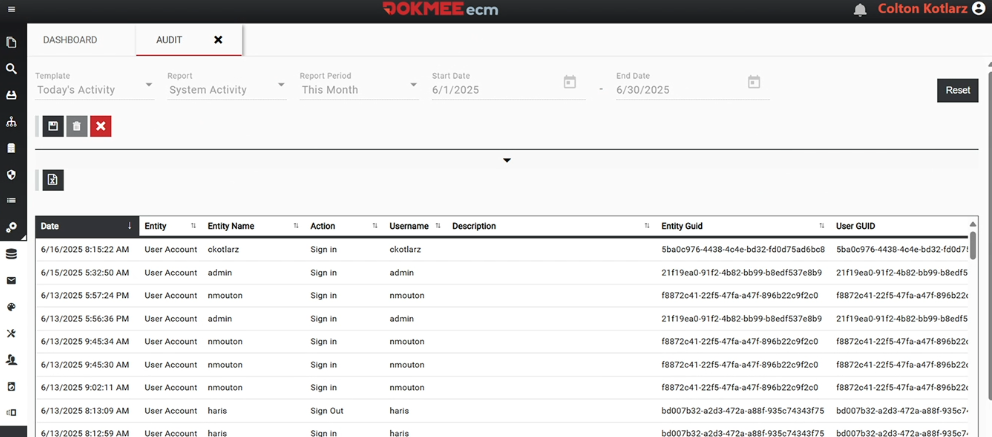
This level of control directly impacts regulatory compliance and risk management. Sensitive information stays protected, and organizations can prove it.
In healthcare, patient records must comply with strict privacy regulations. A DMS ensures that clinicians, administrators, and billing teams only access the information necessary for their role, while audit logs support compliance reviews and investigations.
In human resources, employee records, performance reviews, and disciplinary documents contain highly sensitive data. A DMS prevents unauthorized access while allowing HR teams to retrieve documents instantly when needed.
In financial services, documents such as loan applications, tax records, and investment statements require long-term protection. A DMS secures these records while providing traceability for audits and regulatory inquiries.
Enforced retention policies
Retention policies in a DMS automate how long documents are stored, when they are archived, and when they are disposed of. These rules are applied consistently at scale, removing reliance on individuals remembering retention requirements or manually deleting files.
The operational impact is significant. Storage stays clean, legal exposure is reduced, and audits become far less disruptive.
In accounting firms, tax records must be retained for defined periods depending on jurisdiction. A DMS ensures documents are retained correctly and destroyed when permitted, reducing liability.
In legal environments, case files must often be retained long after a matter closes. A DMS enforces these timelines automatically, preventing premature deletion or unnecessary long-term storage.
In manufacturing, quality and compliance documentation must be retained for regulatory and safety reasons. Automated retention ensures historical records remain accessible for inspections and recalls.
Keep your documents always updated
Version control guarantees there is always one active version of a document while saving a complete history of changes. Each revision is timestamped, attributed, and recoverable.
This prevents errors caused by outdated or conflicting information and builds trust in documentation across the organization.
In operations and compliance, policies and procedures change frequently. A DMS ensures employees always access the latest approved version while maintaining historical records for audits.
In engineering and manufacturing, design documents evolve over time. Version control prevents teams from building or producing based on outdated specifications, reducing rework and material waste.
In marketing, brand guidelines and campaign assets change often. A DMS ensures teams use current messaging and visuals, preserving brand consistency.
Integrates with major productivity platforms
Direct integration with productivity tools drives adoption and efficiency. A DMS allows users to work directly within Word, Excel, and PowerPoint while keeping document control, versioning, and security behind the scenes.
eSignatures remove friction from approvals, while annotations and comments keep collaboration centralized.
In sales, proposals may be created in Word, pricing models in Excel, and presentations in PowerPoint. A DMS allows these documents to move through review, approval, and signature without leaving the system, accelerating deal cycles.
In procurement, contracts and vendor agreements are edited, approved, signed, and stored automatically. No manual uploads, no lost documents.
In executive leadership, board decks and strategic documents are reviewed collaboratively, signed off, and archived with full audit trails.
Define clear access controls
Access controls allow organizations to define who can view, edit, approve, or delete documents at a granular level.
This ensures employees only see information relevant to their role and prevents accidental or unauthorized changes.
The result is improved security, clarity, and accountability, particularly with the use of customized watermarks.
In manufacturing, production teams may need read-only access to work instructions, while engineering teams retain edit rights. A DMS enforces this structure automatically.
In legal and compliance, only designated reviewers can approve final documents, ensuring governance standards are met.
In education or training environments, instructors can update materials while learners access finalized content without modification rights.
Capture documents automatically
Automatic document capture transforms how information enters the organization. A DMS can ingest documents from scanners, email, and applications, then apply OCR and metadata to make them searchable instantly.
This reduces manual effort, eliminates filing errors, and accelerates downstream workflows.
In accounts payable, invoices are captured automatically from multiple sources and routed for approval, reducing processing time and late payments.
In insurance, claims documentation arrives in many formats. Automatic capture ensures files are indexed correctly and available to adjusters immediately.
In logistics, shipping documents and proof of delivery are captured and stored in real time, improving traceability and dispute resolution.
Keep a single source of truth
A single source of truth ensures that every document lives in one authoritative system, governed by consistent rules. This takes out all confusion, reduces duplicated effort, and enables confident decision-making.
Additionally, this makes your teams much more efficient, as every member can access the most updated and valid document at a moment’s notice, whether it is to solve an issue or during a client meeting.
The value of this benefit compounds as organizations grow. Teams stop questioning document accuracy and start relying on the system.
In audits, documentation is retrieved quickly and confidently.
In operations, teams execute based on trusted information.
In leadership, decisions are made using accurate, current data.
This means no documents are lost, no team member wastes time finding the most accurate document, and the organization operates with clarity and confidence.
How to implement a DMS
Implementing a DMS is not just a technical project; it’s an operational one.
The process begins with understanding how documents flow through the organization today. Identifying where documents originate, how they’re used, who touches them, and where delays occur provides the foundation for a successful implementation.
From there, requirements must be clearly defined.
Security, compliance, scalability, integrations, and usability should all be evaluated. The goal is not to replicate existing chaos in a new system, but to design a cleaner, more intentional structure.
Once the platform is selected, document structures, metadata, and permissions should be planned carefully before migration. Aside form deciding if you want to have your DMS based entirely on the cloud, or if you want to take a hybrid approach and store the most sensitive data on local servers.
Even though a DMS has many features to enhance security, such as encryption and multiple factor authentication, some extremely sensitive documents are better off stored on-premise.
This upfront work determines how easy documents will be to find and manage long term. Training is equally critical. A DMS only delivers value if users understand how to use it consistently.
When implemented carefully, a DMS quickly becomes part of daily operations rather than an additional tool employees must remember to use.
What is the Best DMS on the Market in 2026?
In 2026, Dokmee stands out as one of the most complete document management systems available.
Its strength lies in combining enterprise-grade functionality with an intuitive user experience and a flexible, modular pricing model, in a fully customizable DMS or ECM.
Dokmee allows you to start with basic document management and expand into advanced capabilities such as document capture, enterprise content management, and eForms as your needs evolve. This modular approach prevents overpaying for unused features while still offering a clear growth path.
The platform delivers strong security, detailed audit trails, seamless Microsoft Office integration, built-in annotations, reliable version control, and scalable architecture suitable for both small teams and large enterprises.
Additionally, Dokmee offers two types of workflow builders depending on your IT capabilities and needs. These ensure you can automate all processes and users receive notifications when an action is required.
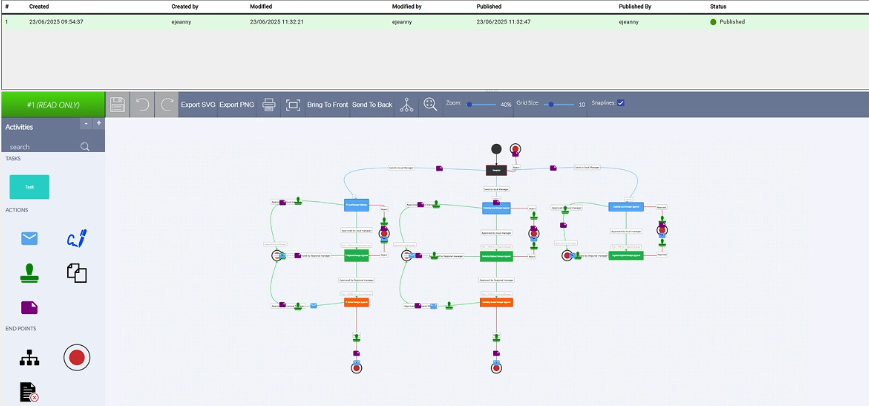
Its design prioritizes usability, which directly impacts adoption and long-term success.
For organizations that want structure without unnecessary complexity, Dokmee strikes a rare balance.
So… Do You Need a DMS?
In short, yes.
A DMS is no longer about reducing paper, it’s about building a completely efficient platform to unify all departments.
A well-implemented DMS improves collaboration, strengthens security, enforces compliance, accelerates workflows, and ensures every team operates from a single source of truth.
In an environment where information accuracy and speed directly affect performance, the right DMS becomes a competitive advantage.
Platforms like Dokmee demonstrate how document management has evolved into a strategic capability rather than a back-office function.
If you’re ready to start reaping all these benefits, book a demo with Dokmee today.