Microsoft SharePoint Review: Does It Work as an Enterprise DMS?
SharePoint delivers powerful document libraries, flexible team portals, and enterprise security, but requires heavy governance and third-party tools for true ECM workflows. Here is our full review.
Microsoft sells SharePoint as an all-purpose collaboration platform, and for teams already living Microsoft 365, it largely delivers on that.
But “collaboration platform” and “document management system” aren’t the same thing, and the gap between them matters.
This review breaks down what SharePoint actually does, how real G2 and Capterra reviewers rate it, what it costs, and where it holds up.
👍 If you’re looking for great SharePoint alternatives, we’ve got that covered. To understand the difference between OneDrive and SharePoint, read our comparison.
Is SharePoint worth it? Yes, it is worth it if your organization already runs on Microsoft 365. Here’s the quick version:
SharePoint is a web-based collaboration and content management platform built into Microsoft 365.
Rated 4.0 out of 5 on G2 (8,975+ reviews) and 4.4 out of 5 on Capterra (5,400+ reviews).
Best suited to organizations already standardized on Microsoft 365 that need team sites, intranets, and document collaboration.
Strong on Microsoft integration, real-time co-authoring, and enterprise compliance tooling through Purview.
Weaker on document capture, OCR, native records management, and ease of administration at scale.
What Is Microsoft SharePoint?
Microsoft SharePoint is a web-based collaboration and document management platform that helps organizations store, organize, share, and manage business content.

As part of Microsoft 365, it connects document collaboration, internal intranet sites, and business process automation in one place. Its primary focus is broader than document management alone.
SharePoint includes version control, permissions, metadata, search, and co-authoring, but it’s designed as a collaboration and content platform first, one that brings together documents, communication, and different teams or departments.
Who Is Microsoft SharePoint Built For?
SharePoint is best suited to organizations that need a central platform for collaboration, document sharing, and internal knowledge management, particularly those already using Microsoft 365.
Small and medium-sized businesses building shared document libraries, department sites, or a company intranet without a separate platform
Larger enterprises supporting cross-functional collaboration and secure information access across multiple locations
Common industries include the government, education, healthcare, financial services, and manufacturing.
Common use cases include document collaboration, policy management, project documentation, employee onboarding, knowledge bases, and contract libraries.
What Are Microsoft SharePoint’s Features?
SharePoint combines document management, collaboration, content management, and business process automation within Microsoft 365.
Here’s how each feature works, along with what’s worth knowing before you build on it.
Document Management
SharePoint's document management centers on Document Libraries: secure, organized storage for team content.
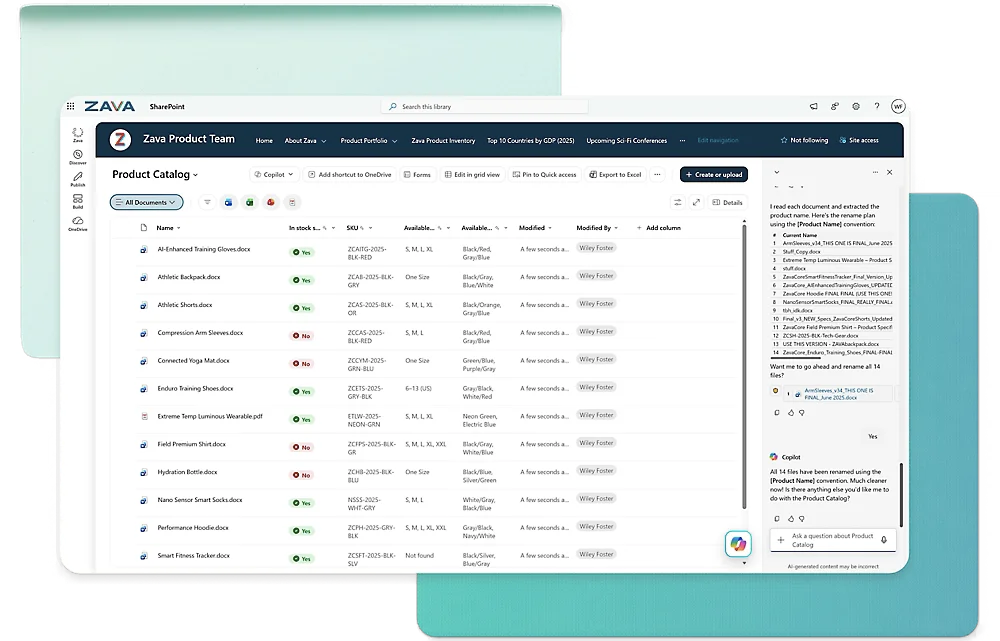
Centralized storage through Document Libraries, organized with metadata (customer, project, department, and document type) rather than just folders
Version history plus check-in and check-out controls to prevent overwrite conflicts
Real-time co-authoring in Word, Excel, and PowerPoint
⚠️ Watch Out: Effective document management depends heavily on well-planned information architecture. Without governance, document libraries and permissions can become difficult to manage as content grows.
Intranet and Team Sites
One of Microsoft SharePoint’s best strengths is its team sites and intranet support.
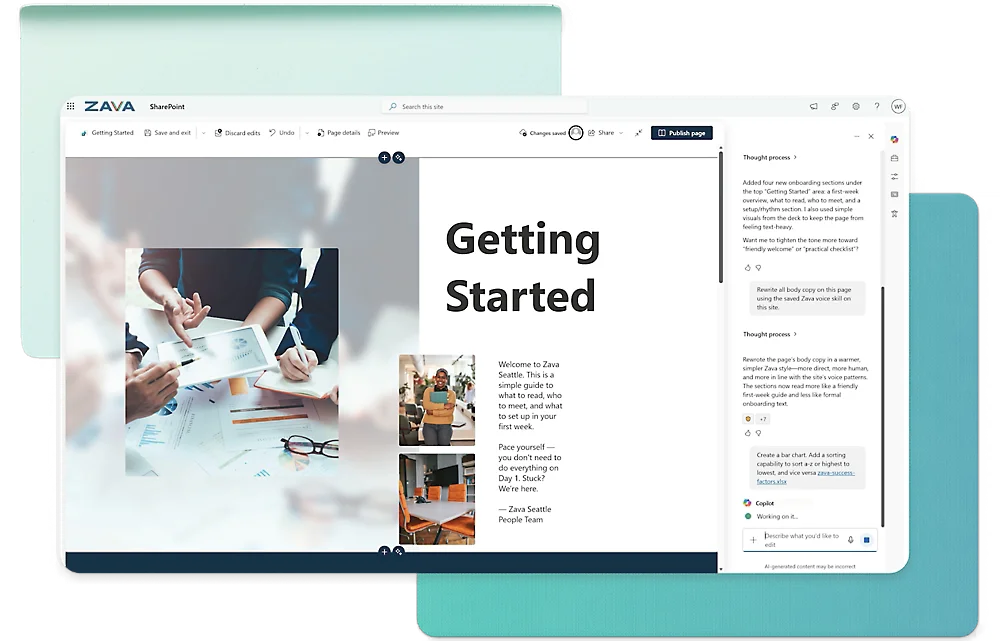
Dedicated team sites and communication sites for departments, projects, or business units
Each site can include document libraries, calendars, announcements, task lists, and dashboards.
No-code page creation and templates for building an intranet without a developer
A common use case is an HR department building an employee portal for onboarding documents, policies, and announcements.
⚠️ Note: Highly customized or heavily branded intranets typically still need support from IT or a SharePoint developer, even with no-code tools available.
Workflow Automation
Workflow automation runs through Microsoft Power Automate rather than being fully native to SharePoint, similar in spirit to any document management workflow tool, but built on Microsoft's wider ecosystem.
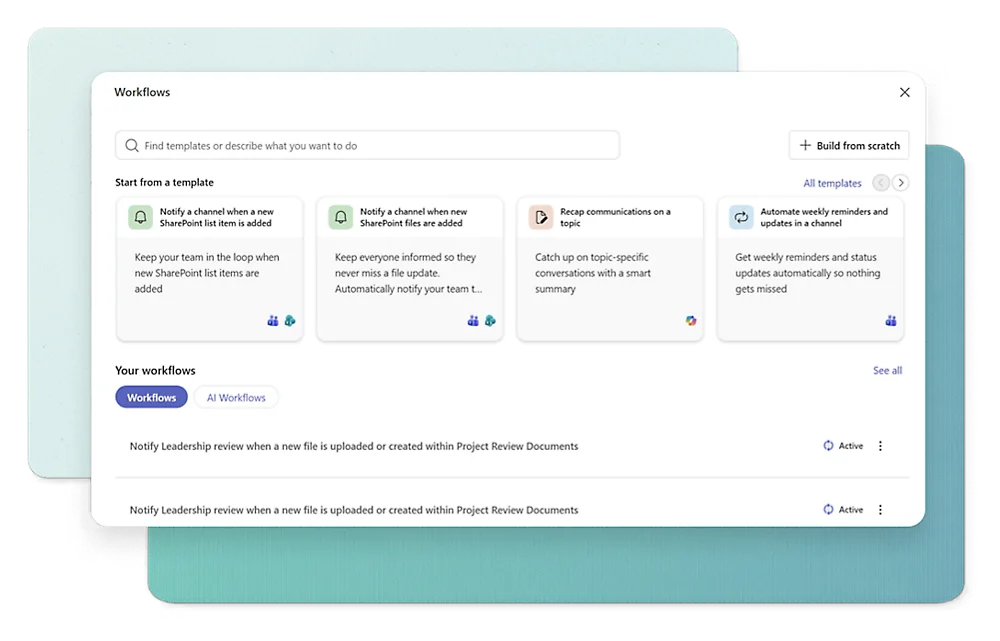
Automate document approvals, notifications, file routing, and reviews
For example, uploading a contract can automatically trigger an approval workflow, notify reviewers, and archive the final document once complete.
Simple workflows use a visual, drag-and-drop interface
⚠️ Watch Out: More complex automations involving multiple systems or custom business rules typically require technical expertise, since workflow automation lives in Power Automate rather than being entirely native to SharePoint.
Security and Compliance
SharePoint includes enterprise-grade document management security features designed to protect sensitive information and support compliance.
Granular permissions at the site, library, folder, or document level
Microsoft Purview coverage: data loss prevention, retention policies, sensitivity labels, audit logs, and legal holds
Records management capabilities through Purview and SharePoint Premium
⚠️ Watch Out: Managing permissions, retention policies, and governance across large SharePoint environments gets complex fast. Many organizations end up investing in dedicated governance strategies or third-party tools to keep it under control.
AI Features
SharePoint’s newer AI features lean heavily on Microsoft 365 Copilot and Work IQ.
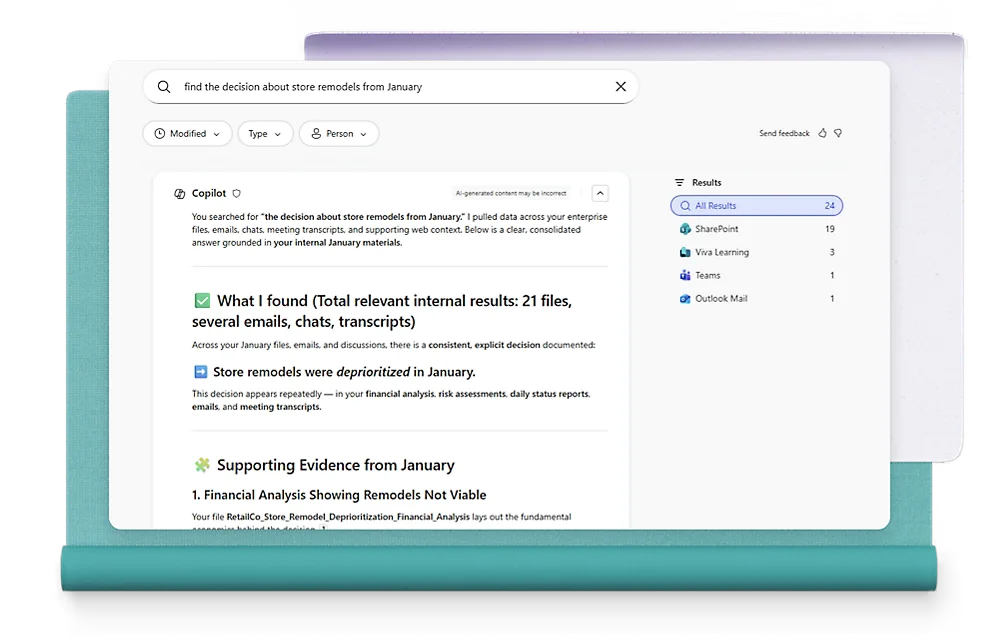
Work IQ grounds Copilot in your organization’s SharePoint content for more relevant answers.
AI-powered search aims to understand intent rather than just matching keywords.
A SharePoint Admin Agent assists with AI-powered governance at scale.
Copilot can draft pages and sites from natural language descriptions.
Several of these features remain in public preview and may require additional licensing beyond a standard plan.
It's also worth knowing that this is general-purpose AI assistance, not the specialized AI document indexing or AI document search that a purpose-built document platform provides.
Cloud Deployment
Microsoft's investment has shifted almost entirely to SharePoint Online, though on-premises technically remains an option.
SharePoint Online: cloud-hosted, continuously updated as part of Microsoft 365
SharePoint Server: on-premises, though SharePoint Server 2019's extended support ended on July 14, 2026.
Hybrid: possible, but adds administrative complexity
❌ Important: Organizations still running SharePoint Server 2019 no longer receive security patches or technical support as of July 2026. That’s a security exposure, not just an inconvenience, and migration planning shouldn’t wait.
Native Integration
SharePoint integrates natively with Microsoft 365. Here’s what that entails:
Word, Excel, Outlook, Teams, and OneDrive for daily document work
Power Automate for workflow automation
Power BI for reporting and dashboards
Power Apps for custom, low-code applications built on SharePoint data
What Are the Pros and Cons of Microsoft SharePoint?
Across both G2 and Capterra, users consistently point to Microsoft 365 integration as the reason they stick with SharePoint.
The recurring complaint is about administration: permissions, site structure, and governance take planning, especially for smaller teams without dedicated IT support.
Platform | Rating | Consensus |
|---|---|---|
G2 | Praised for Microsoft 365 integration, real-time co-authoring, and flexibility; the recurring complaints are a steep learning curve and complex administration. | |
Capterra | Strong marks for centralizing documents and collaboration, with new users often finding the interface overwhelming at first. |
The star ratings are close across platforms, but here’s what else users praise and warn about:
Pros | Cons |
|---|---|
✅ Native integration with Microsoft 365, especially Teams, Outlook, and Office | ❌ Steep learning curve for administrators and new users |
✅ Strong document collaboration with real-time co-authoring | ❌ Initial setup, information architecture, and permissions can be time-consuming |
✅ Flexible platform, adaptable from simple file sharing to full intranets | ❌ Advanced workflows and automation require Power Automate |
✅ Granular permissions and enterprise-grade security | ❌ Performance can suffer when managing very large document libraries |
✅ Powerful search when metadata is correctly assigned | ❌ Licensing costs can climb when additional Microsoft products are needed for ECM features |
How Much Does Microsoft SharePoint Cost?
SharePoint doesn't have a standalone consumer price tag.
It's bundled into Microsoft 365 Business plans alongside OneDrive, Teams, and the core Office apps, so there's one price per user rather than a separate SharePoint line item.
Plan | Price (without Teams) | Price (with Teams) | What You Get |
|---|---|---|---|
Business Basic | $5.40/user/mo. | $7.00/user/mo. | SharePoint sites and libraries, 1TB OneDrive storage per user, web and mobile Office apps |
Business Standard with Copilot | $20.30/user/mo. | $23.50/user/mo. | Adds desktop apps and work-grounded Copilot across SharePoint and Microsoft 365 content |
Business Premium with Copilot | $28.80/user/mo. | $32.00/user/mo. | Adds advanced device management and threat protection |
👍 Note: All subscriptions are billed annually. Plans without Teams are priced slightly lower but still include full SharePoint access. Either way, SharePoint itself was never a separate purchase.
Who Should Use SharePoint?
SharePoint’s strengths make it ideal primarily for organizations deep into the Microsoft ecosystem.
Good Fit | Why |
|---|---|
Organizations already standardized on Microsoft 365 | Native integration with Teams, Outlook, and Office means no separate collaboration tool to license or learn |
Companies building an internal intranet or knowledge base | Team sites and communication sites cover this natively, with no-code page creation |
Teams needing structured document collaboration with real-time co-authoring | Built-in version history, metadata, and permissions support this out of the box |
Enterprises needing compliance tooling | Microsoft Purview covers DLP, retention, sensitivity labels, and legal holds within the same ecosystem |
Who Shouldn’t Use SharePoint?
The same flexibility that makes SharePoint great is also where it becomes the wrong fit for certain teams.
Poor Fit | Why |
|---|---|
Small teams or solo users without Microsoft 365 already | The learning curve and administrative overhead outweigh the benefit for simple file sharing |
Teams needing high-volume document capture or OCR | SharePoint doesn't natively scan, extract, or index paper documents |
Organizations without dedicated IT or governance resources | Permissions and site structure sprawl quickly without deliberate planning |
Teams wanting AI-driven document classification | Copilot assists with content, but doesn't automatically classify or tag documents the way a purpose-built DMS does |
How Does SharePoint Compare to Dokmee?
SharePoint and Dokmee solve different problems well. See the full breakdown in our Dokmee vs. SharePoint comparison, or the quick summary below.
SharePoint | Dokmee | |
|---|---|---|
Primary focus | Collaboration, intranets, and content management | Enterprise content management and document management |
Deployment | Cloud (SharePoint Online); on-premises support for Server ended July 2026 | Cloud, on-premises, or hybrid |
Document management | Strong, collaboration-focused | Purpose-built, with Magic Indexing and AI Scripting for advanced governance |
Workflow automation | Via Microsoft Power Automate | Native visual workflow designer |
AI capabilities | Copilot, Microsoft Search, SharePoint Premium (may require added licensing) | Built-in AI Search and AI-powered document classification |
Records management | Via Microsoft Purview (additional licensing) | Built-in retention and records management |
Starting price | Bundled into Microsoft 365 Business, from $5.40/user/mo. | $39/mo. per user |
Microsoft SharePoint Review: Is It the Right Choice for Your Business?
SharePoint excels at team collaboration for organizations already living in Microsoft 365. However, as a dedicated document management system, it’s quite limited.
It lacks native OCR, its AI focuses on content creation and search rather than classification, and automated records management requires expensive Purview licensing.
If you manage regulated, high-volume records, you’ll quickly outgrow what SharePoint offers out of the box.
Want built-in OCR, automated retention, and AI classification without stacking Microsoft licenses? See a platform built specifically for document management.